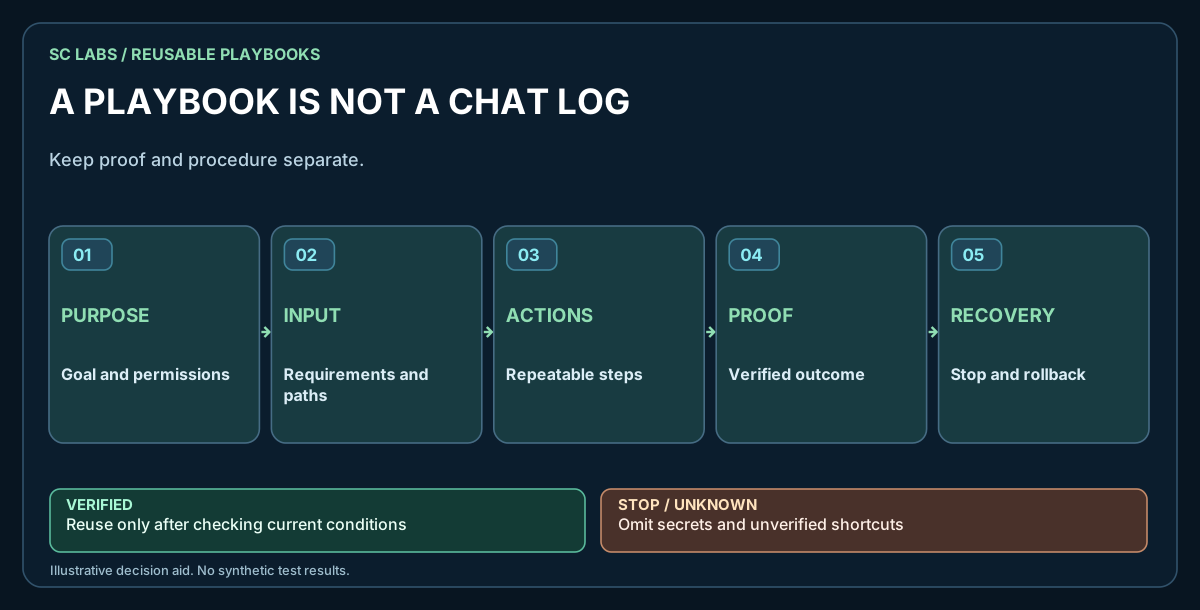
A chat transcript is not a playbook
A transcript records everything that happened, including dead ends. A useful playbook records what a future operator needs to recognise the situation, choose the shortest known safe route and prove that the job is actually complete.
Start only after the result is verified
Do not promote an unverified attempt into reusable procedure. First establish the postcondition: the device is visible, the driver is working, the PC is stable, the files are recovered, the remote session is gone or whatever the real success condition was.
What a useful playbook should preserve
A reusable playbook should keep enough context to recognise the task again, the route that was actually proven, the checks that confirm success and the important cleanup or caution points. The exact internal structure does not need to be exposed publicly; what matters to the user is that the result remains understandable and reusable.
Example: a USB device that looked dead
A laser engraver that was not visible to its application did not need random application reinstall attempts. The useful sequence was lower-level: confirm Windows USB enumeration, restore the serial path, identify the COM port, verify the controller protocol and only then configure the engraving software.
Example: a PC prepared for sale
A resale PC needs more than “Windows boots”. A reusable closeout playbook checks hardware identity, problem devices, updates, security state, startup load, storage health, drivers, activation, practical stability and finally removes every temporary support artefact before handover.
Make verification part of the procedure
A service removal is not complete because a command returned zero; it is complete when the service is absent. A USB driver is not fixed because setup completed; it is fixed when the expected device and protocol respond.
Keep the learning explicit and user-controlled
This is not hidden self-training. The useful experience is written down as an inspectable procedure that can be corrected, versioned or discarded. That keeps operational learning portable across model changes instead of burying it in one conversation.
Why this matters for ARKTOR users
The goal is simple: after ARKTOR helps complete and verify a meaningful task, the useful experience should not disappear with the session. It can become a private, user-controlled guide for the next similar job. That helps ARKTOR start with known experience while still checking the current device, permissions and conditions before acting.
Playbooks should remain inspectable and editable by the user. They are a way to retain operational knowledge, not a reason to hide decisions or bypass fresh verification.
Private by default
A user's operational playbooks should belong to that user. They should not be automatically published, shared or treated as public documentation. Public SC LABS material can explain the idea; the detailed working knowledge stays in the user's controlled knowledge layer unless the user explicitly chooses otherwise.
The useful outcome
The next session begins with accumulated operational knowledge instead of repeating discovery from zero. The human still decides whether the old procedure applies; the AI gets a better starting point because the previous work produced evidence and a reusable route.
Want a repeatable automation?
Start with one verified task and document the steps, approvals and recovery conditions. A pilot starts with a scoped conversation, not a promise of public product availability.
Discuss a scoped ARKTOR pilot